
Mazda CX-3: Winter Driving / Tire Chains
Mazda CX-3 (2015-2026) Owner's Manual / Before Driving / Driving Tips / Winter Driving / Tire Chains
Check local regulations before using tire chains.
CAUTION
- Chains may affect handling.
- Do not go faster than 50 km/h (30 mph) or the chain manufacturer's recommended limit, whichever is lower.
- Drive carefully and avoid bumps, holes, and sharp turns.
- Avoid locked-wheel braking.
- Do not use chains on a temporary spare tire; it may result in damage to the vehicle and to the tire.
- Do not use chains on roads that are free of snow or ice. The tires and chains could be damaged.
- Chains may scratch or chip aluminum wheels.
NOTE
If your vehicle is equipped with the tire pressure monitoring system, the system may not function correctly when using tire chains.
Install the chains on the front tires only. Do not use chains on the rear tires. Please consult an Authorized Mazda Dealer.
Installing the chains
- If your vehicle is equipped with wheel covers remove them, otherwise the chain bands will scratch them.
- Secure the chains on the front tires as
tightly as possible.
Always follow the chain manufacturer's instructions.
- Retighten the chains after driving 1/2―1 km (1/4―1/2 mile).
 Snow Tires
Use snow tires on all 4 wheels
Do not go faster than 120 km/h (75 mph)
while driving with snow tires. Inflate snow
tires 30 kPa (0.3 kgf/cm2, 4.3 psi) more
than recommended on the tire pressure
label (driver's door frame), but never more
than the maximum cold-tire pressure
shown on the tires...
 Driving In Flooded Area
WARNING
Dry off brakes that have become wet by
driving slowly, releasing the accelerator
pedal and lightly applying the brakes
several times until the brake performance
returns to normal:
Driving with wet brakes is dangerous...
Other information:
Mazda CX-3 (2015-2026) Owner's Manual: Introduction
Bluetooth® Hands-Free outline When a Bluetooth® device (mobile phone) is connected to the vehicle's Bluetooth® unit via radio wave transmission, a call can be made or received by pressing the talk button, pick-up button, or hang-up button on the audio remote control switch, or by operating the center display...
Mazda CX-3 (2015-2026) Owner's Manual: Adjusting the Vents
Directing airflow To adjust the direction of airflow, move the adjustment knob. NOTE When using the air conditioner under humid ambient temperature conditions, the system may blow fog from the vents. This is not a sign of trouble but a result of humid air being suddenly cooled...
Categories
- Manuals Home
- Mazda CX-3 Owners Manual
- Mazda CX-3 Service Manual
- Fuel Gauge
- Engine Start Function When Key Battery is Dead
- Trip Computer and INFO Switch (Some models)
- New on site
- Most important about car
Transmitter
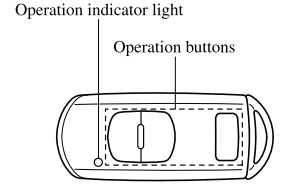
NOTE
The headlights turn on/off by operating the transmitter. Refer to Leaving Home Light. (With theft-deterrent system)The hazard warning lights flash when the theft-deterrent system is armed or turned off. Refer to Theft-Deterrent System.
(With the advanced keyless function)
Copyright © 2026 www.macx3.net